Owners of Record
Owners of Record
Information about the owners of record for the property at the corner of Main and Grand Streets in Middletown, CT
James Bowdoin, First Owner of Record
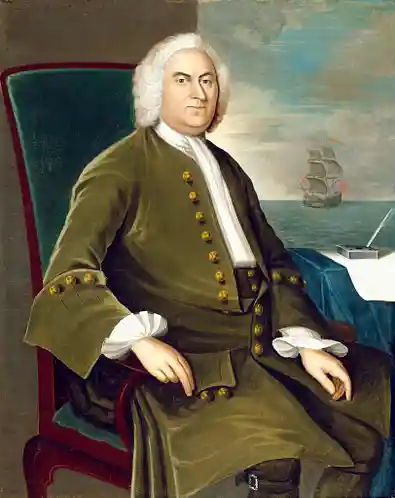
The first owner of record we have for the property at the corner of Main and Grand Streets is James Bowdoin (1676-1747) of Boston. His father, physician Pierre Baudouin (1640-1706) took his family first to Ireland, then to Casco, Maine and finally to Boston in 1690 as they fled La Rochelle, France after their estate was confiscated following the Revocation of the Edict of Nantes in 1685. This royal decree by King Louis XIV ended religious rights for French Protestants (Huguenots) and made Catholicism mandatory in France. By the 1680s, King Louis XIV sought absolute religious and political uniformity (“one king, one law, one faith”) and used state terror and violent military quartering known as dragonnades to force mass conversions to Catholicism.
Despite the law that forbade emigration, roughly 200,000 to 250,000 Huguenots fled France for neighboring Protestant nations like England, the Dutch Republic, Switzerland, Germany, and the American colonies. In Boston, the Huguenots established the French Church and Boston’s Puritans welcomed them with a mix of shared Calvinist theological empathy and typical colonial caution regarding their French heritage. Family names of Huguenot refugees such as Bowdoin, Revere and Faneuil are still known today.
James Bowdoin was a particularly successful example of the refugees that came to New England. He started his career as a mariner and quickly became one of the most influential and wealthiest merchants in Massachusetts with extensive land and real estate holdings. Additionally, he exercised political influence as a member of the Governor’s Council and justice of the peace and of the Quorum. When he died in 1747, his estate was valued at £82,000 – described as probably the largest fortune until then accumulated by a New Englander.
His obituary published on September 15, 1747 in the Boston Gazette recalled a man that all admired:
“Last Tuesday Evening died here in the 71st Year of his Age the Hon. James Bowdoin, Esq; a Gentleman possessed of an ample Fortune, which he acquired by unparallelled industry: — His Uprightness in his Dealings, his great Lenity to his numerous Debtors; his Integrity in every Affair he undertook the Management of ; and his Readiness to relieve the Distressed ; will ever render his Memory grateful, especially among those who have personally experienced these Virtues in him.”
“In all the Relations of Life he maintained a truly amiable Character ; as a Husband, Father and Friend, he was tender, loving and sincere.”
“He was for several Years a Member of his Majesty’s Council in which Station he behaved with his wonted Integrity, making Justice the Rule of his Actions, and the publick Good his main Concern ; and this with a Resolution which nothing could abate.”
”His corps was interred on Friday last with the Honour and Solemnity which became so worthy a Gentleman.”
He was married three times and of ten children five survived infancy. His namesake, the second James Bowdoin (1726-1790), was born in Boston, Massachusetts, and graduated from Harvard (1745). He was nominally engaged in business but focused much of his time on government and intellectual pursuits. He enjoyed a close relationship with Benjamin Franklin and was a Fellow of the Royal Society. He was politically active and became the second Governor of Massachusetts (May 27, 1785 – May 30, 1787) and first President (1780) and Co-Founder of the American Academy of Arts & Sciences. His son, the third James Bowdoin (1753-1811), donated land from the family estate in Brunswick, Maine, as well as funds and books, to establish Bowdoin College in his honor.
Among the first James Bowdoin’s real estate holdings was a tract of land on Main Street in Middletown of approximately eleven acres. By 1740, Middletown, with its deepwater port, held a unique and highly profitable niche as a premier inland riverport. It hosted shipbuilding yards, sailmaking, and ropeworks (essential for fabricating maritime hemp lines). Located at the “big bend” of the Connecticut River, it was the trading midpoint between upper river towns (Hartford, Windsor) and the Long Island Sound. Merchant ships from Middletown traveled the east coast of the colonies and to the Caribbean. As his heirs focused the Bowdoin real estate legacy on holdings In Maine, they sold this tract of land to Captains Philip Mortimer and John Keith about 1751.